


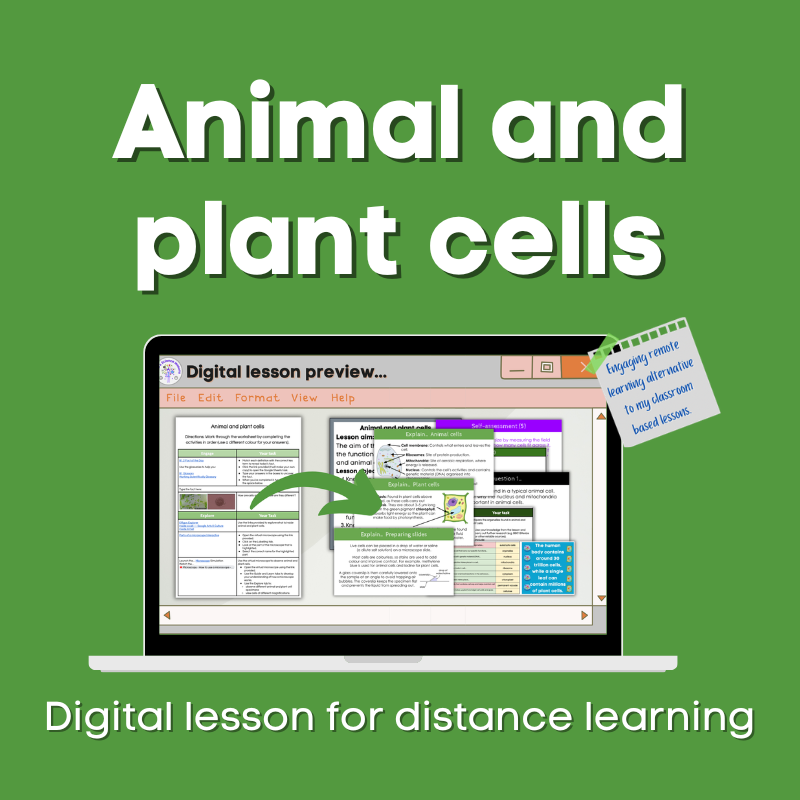

This GCSE distance learning lesson on Animal and plant cells helps students develop their understanding of the function of organelles in plant and animal cells through clear explanations, digital activities, and structured independent tasks.
This is the 2nd in a series of lessons and covers the content from the AQA GCSE 4.1.1 Cell structure & 4.1.3 Transport in cells topics and OUP Kerboodle Scheme B1.2 Animal and plant cells lesson.
The worksheets are fully editable so you can adapt the tasks to your students and the time available.
This adaptable resource is ideal for:
- Remote learning – Designed for students to work independently from home or school.
- Catch-up work – Supports students who have missed classes.
- Home schooling – Provides a complete and structured learning sequence.
While primarily written for UK students using British English spellings and vocabulary, the core content and activities can be easily adapted for students in other countries with similar educational systems.
Aimed at a mixed ability GCSE class.
This editable resource includes (8 pages):
- Teacher guidance and answer key – Clear notes and fully worked solutions to support remote instruction and feedback.
- Engage – A Google Sheets™ vocabulary activity to introduce key terms.
- Explore – Interactive tasks using virtual microscopes and simulations where students:
- ○ Observe animal and plant cells
- ○ Identify parts of a microscope
- ○ Record observations from different magnifications.
- Explain – n embedded Google Slides™ presentation with accessible explanations and self-check questions covering:
- ○ Cell structure and organelle function
- ○ Differences between animal and plant cells
- ○ Microscopy techniques and cell measurement.
- Apply – Differentiated tasks for practising and applying learning, including:
- ○ Labelling cell diagrams and describing functions
- ○ Analysing micrographs and calculating cell size
- Extend – A challenge activity to support higher-level thinking.
- ○ Comparing organelles in animal and plant cells, including their function, size, and differences
Important:
- Internet Access: A computer with internet access is required.
- Google Doc™ Format: This resource works best in Google Docs™. Some tasks may not function correctly in Word/Excel versions.
This lesson is also available as a:
- Teacher-led lesson: Fully resourced PowerPoint presentation with worksheets.
- Cover lesson worksheet: A ready-to-use printable version for substitute teachers.